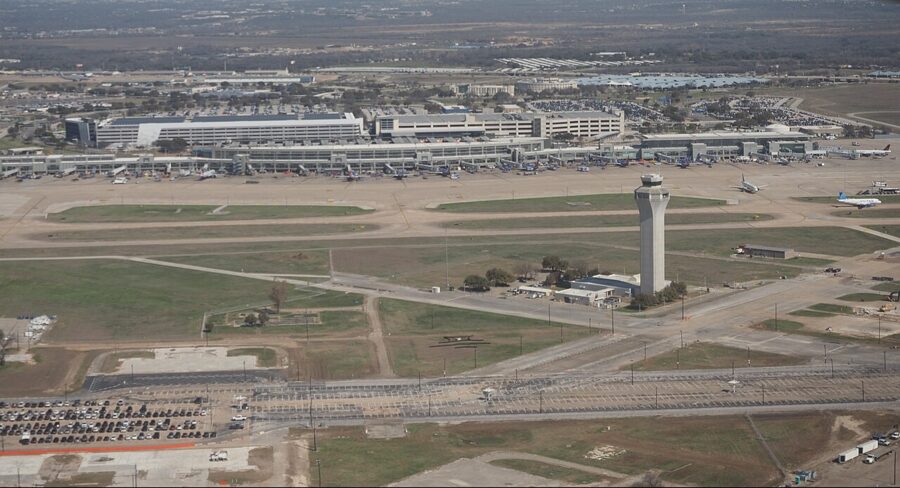
Allow two hours before a domestic flight from Austin-Bergstrom International Airport and three hours before an international one. That is the airport’s own advice as of November 2026, and on a busy day, which AUS defines as more than 40,000 departing travelers, it asks for two and a half hours before a domestic flight.
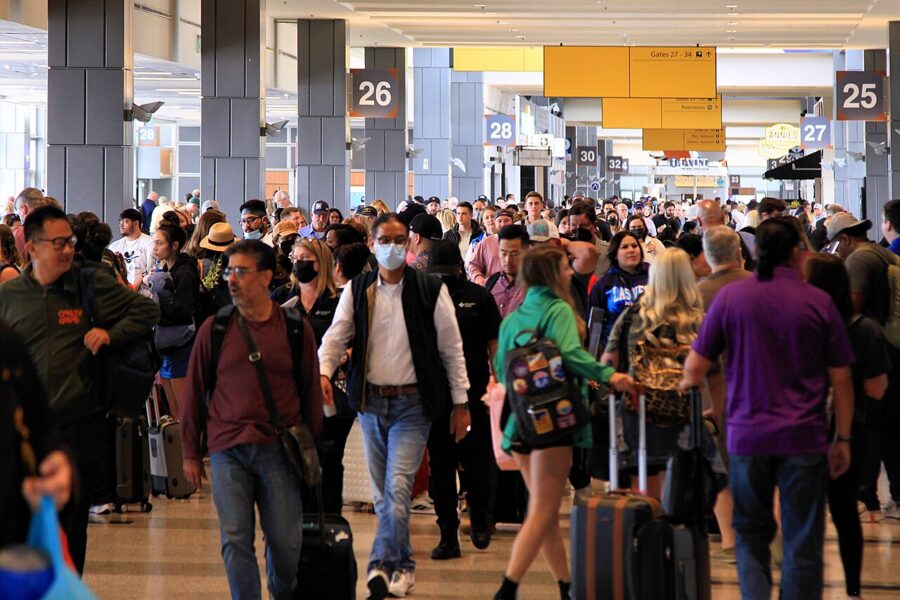
Those busy days are easy to see coming. The Monday after the Formula 1 race is now the busiest day in the airport’s history: the TSA screened 46,963 people at AUS on October 26, 2026, beating the 45,048 screened on the Monday after the 2025 race. A Tuesday two weeks later brought about 23,000, half as many, through the same four checkpoints.
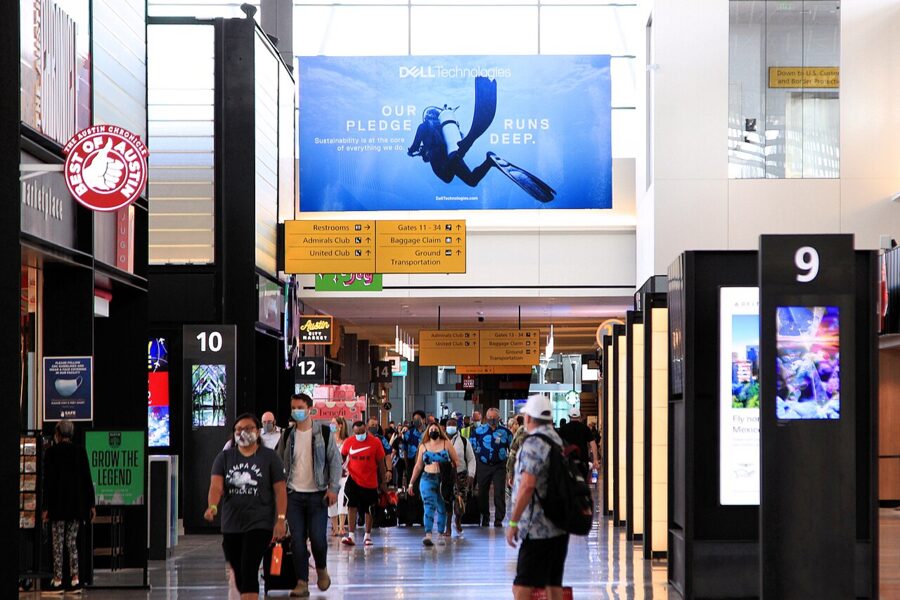
The airport’s shape works in your favor. Like Denver International, AUS screens everyone inside a single terminal, and the airport says all four of its checkpoints lead to all gates. Choosing a checkpoint is about which lanes you qualify for and when you arrive, not where your plane is parked.


On this page
- How long security takes at AUS, and what the numbers can tell you
- The four checkpoints in the Barbara Jordan Terminal
- When AUS is busiest
- Checking the line before you leave
- Ways to get through faster
- Getting to the airport and into the right line
- The South Terminal has closed, and the main terminal is still changing
- AUS security at a glance
How long security takes at AUS, and what the numbers can tell you
Neither the airport nor the TSA publishes an official live minute count for each Austin checkpoint. Any figure you see quoted as “the” wait time at AUS is an estimate. What the TSA does publish, in the FOIA reading room on its website, is the number of people screened at every checkpoint in every hour of every day, released within about a week.
Those counts don’t measure how long anyone stood in line. They do show exactly when the crowds arrive, and a line is simply more people turning up than the open lanes can take. Read together with the airport’s advice, they give you a reliable picture of when AUS is easy and when it isn’t.
The airport’s guidance, as of November 2026, comes in three numbers. Two hours before a domestic flight on a normal day, three hours before an international flight, and two and a half hours before a domestic flight on a busy day. AUS adds that you should allow extra time if you’re checking bags, traveling with small children or a large group, or don’t fly often.
Security is only one of the clocks running against you. Before it come the drive, parking and any bag drop, and after it the walk to the gate and your airline’s boarding cut-off. The two-hour figure covers all of that, which is why it still applies on days when the screening itself is quick.
The four checkpoints in the Barbara Jordan Terminal
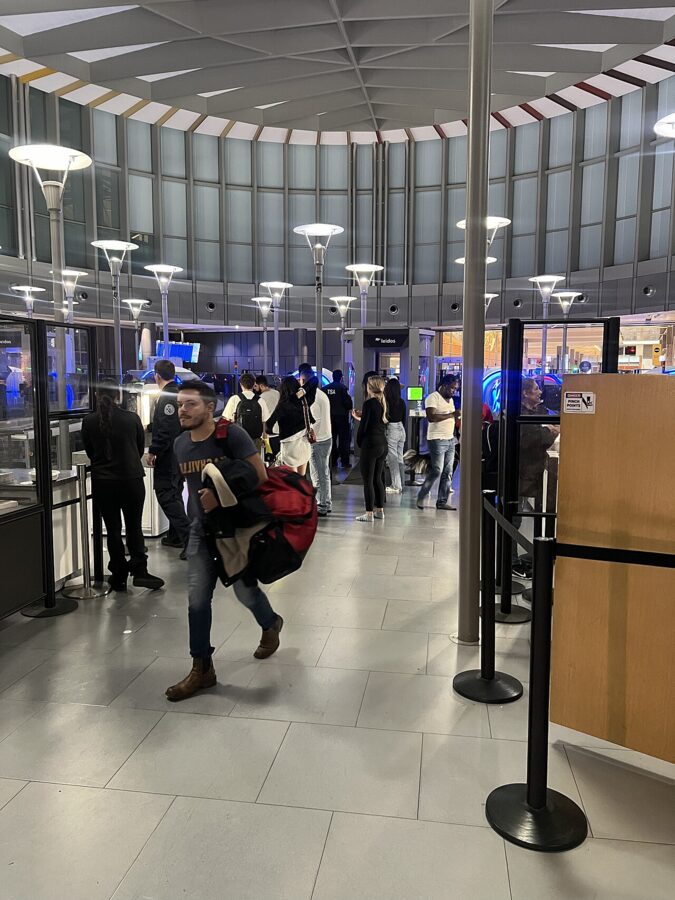
All screening at AUS happens in the Barbara Jordan Terminal, at four checkpoints numbered 1 to 4. They all reach every gate, but they don’t offer the same lanes. This is how the airport lists them as of November 2026:
| Checkpoint | Lanes the airport lists | Best for |
|---|---|---|
| Checkpoint 1 | TSA PreCheck, PreCheck Touchless ID, CLEAR with PreCheck, Known Crew Member, ADA screening, Priority/Premium screening | PreCheck members, CLEAR members who also have PreCheck, late-evening departures |
| Checkpoint 2 | TSA PreCheck | PreCheck members when Checkpoint 1 is busy |
| Checkpoint 3 | General screening, CLEAR for general screening, ADA screening, Priority/Premium screening | Standard screening, CLEAR without PreCheck, priority boarding passes |
| Checkpoint 4 | General screening | Standard screening |
Read the table as two pairs. PreCheck lanes are at Checkpoints 1 and 2; standard lanes are at 3 and 4. CLEAR members go to Checkpoint 1 if they also have PreCheck and to Checkpoint 3 if they don’t, and passengers whose boarding pass shows priority or premium screening use the lanes at 1 or 3.

What changed at the checkpoints in 2026
Checkpoint 4 is the newest. It sits in the West Infill, an addition of more than 75,000 square feet that the airport completed in 2026, and it opened as a four-lane checkpoint with room for up to eight lanes if the TSA needs them. The airport also says CT scanners for carry-on bags are now installed at all four checkpoints.
The work wasn’t painless. Checkpoint 3 was closed for a stretch of the project, and the airport added lanes on both sides of Checkpoint 2 (which it calls 2 West and 2 East) to cover the gap. Checkpoint 3 is open again and is the main home of standard screening and the CLEAR lane for travelers without PreCheck.
Two small things are worth knowing if you’re traveling with children. The airport lists a nursing room near Checkpoint 4 and family restrooms between Checkpoints 2 and 3, so you can sort out a toddler before joining the line rather than in the middle of it.
Opening hours and late-night flights
The first checkpoints typically open at 3am every day, according to the airport. In the TSA’s hourly counts for late October and mid-November 2026, all four checkpoints were screening passengers from the 3am hour on weekdays, so a 5:30am flight does not need a 2am alarm.
Evenings are different. Across both weeks of TSA data, Checkpoint 4 and Checkpoint 2 went quiet first, usually by about 7pm, and Checkpoint 3 followed around 8pm. After that, Checkpoint 1 was the only one recording passengers, PreCheck or not, until the last screening around midnight.
The practical rule: after about 8pm, head for Checkpoint 1 and follow the signs and officers from there. The airport doesn’t publish closing times for each checkpoint, so treat this as the pattern the TSA’s own counts show rather than a timetable.

When AUS is busiest
The TSA’s published throughput for Austin shows the same shape most days, with the size of each peak changing by day of the week and by what’s happening in town. The figures below come from the TSA’s hourly checkpoint counts, all four checkpoints added together and rounded to the nearest 50.
Hour by hour
| Hour starting | Tue, Nov 10, 2026 | Thu, Nov 12, 2026 | Mon, Oct 26, 2026 (after F1) |
|---|---|---|---|
| 3am | 450 | 700 | 1,750 |
| 4am | 950 | 1,850 | 2,950 |
| 5am | 2,250 | 2,750 | 3,100 |
| 6am | 1,400 | 2,750 | 3,250 |
| 7am | 1,350 | 2,600 | 3,300 |
| 8am | 1,200 | 1,700 | 3,000 |
| 9am | 1,600 | 1,450 | 2,750 |
| 10am | 1,650 | 1,800 | 3,150 |
| 11am | 1,950 | 2,700 | 3,050 |
| Noon | 1,800 | 3,000 | 2,700 |
| 1pm | 1,950 | 2,150 | 3,400 |
| 2pm | 1,550 | 2,500 | 2,750 |
| 3pm | 1,800 | 3,000 | 2,900 |
| 4pm | 1,500 | 2,200 | 2,700 |
| 5pm | 800 | 2,150 | 2,100 |
| 6pm | 450 | 1,500 | 1,750 |
| 7pm | 250 | 500 | 1,550 |
| 8pm | under 100 | 550 | 300 |
Three things stand out. The first departure wave, roughly 5am to 7am, is the biggest crunch on an ordinary day; on the quiet Tuesday nearly a tenth of the day’s passengers came through in the 5am hour alone. A second, broader peak builds from late morning to mid-afternoon, and on a busy Thursday it matched the early rush, with about 3,000 people an hour around noon and again at 3pm.
The third is what an event does. On the Monday after the Grand Prix there was no lull at all: every hour from 4am to 4pm brought at least 2,650 people, and most brought more than 2,900. That is why the airport asks for the extra half hour on busy days rather than naming a better time to show up.
The quietest windows on a normal weekday are mid-morning, around 8am to 10am, and the evening after 6pm. If you can choose your flight time, those are the departures where the line is least likely to be the thing that decides whether you make it.

Day by day
Daily totals from the same TSA data show a clear weekly rhythm. These are two weeks in fall 2026, one ordinary and one with the Formula 1 weekend at its start:
| Day | Week of Nov 8, 2026 | Week of Oct 25, 2026 (F1) |
|---|---|---|
| Sunday | about 36,300 | about 42,000 (race day) |
| Monday | about 34,100 | 46,963 (airport record) |
| Tuesday | about 23,000 | about 32,600 |
| Wednesday | about 28,100 | about 27,300 |
| Thursday | about 36,100 | about 35,400 |
| Friday | about 32,800 | about 29,900 |
| Saturday | about 23,800 | about 17,200 |
Sundays, Mondays and Thursdays are the heavy days at AUS. Tuesdays and Saturdays are the light ones, and an ordinary Tuesday can see fewer than half the passengers of the Monday after a major event. Notice too how the race week settled back to normal by Wednesday, once the visitors had gone home.
SXSW, ACL and the Formula 1 weekend
Austin’s big events fill the airport twice: once with arrivals before, and then with everyone leaving at the same time afterwards. The departure day is the one that hits the checkpoints. The airport names Formula 1 race weekends and three-day holiday weekends as typical busy days, and it announces them about a day ahead on its social media accounts and on FlyAustin.com.
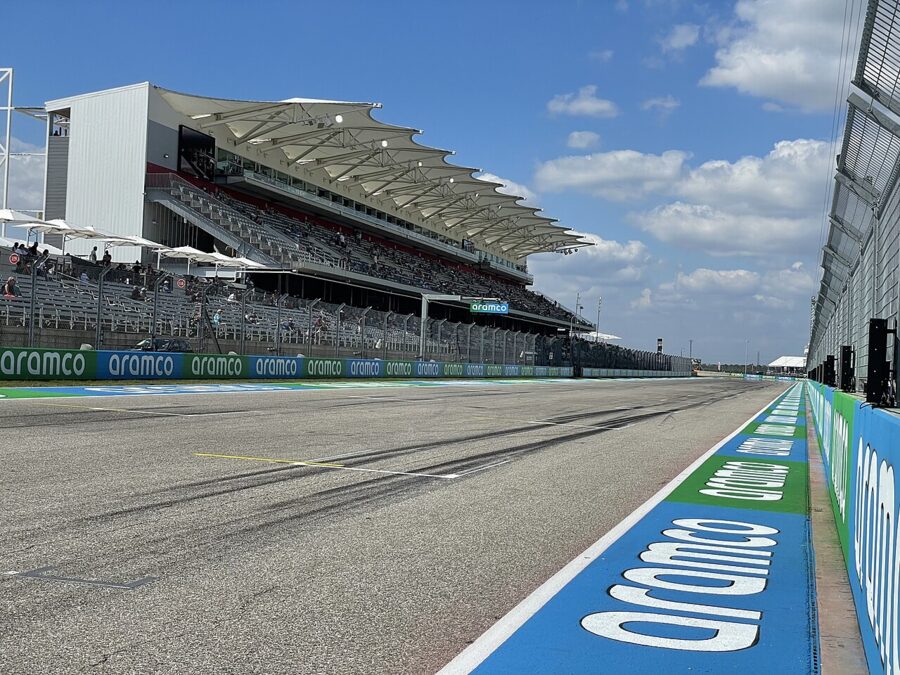
- Formula 1 United States Grand Prix, at Circuit of the Americas: the 2027 race weekend is October 22 to 24, 2027, on the Formula 1 calendar. Expect the Sunday evening and the Monday, October 25, to be the crunch, as they were in 2025 and 2026.
- SXSW: the 2027 festival runs March 15 to 21, 2027, according to SXSW. In 2026 it overlapped with spring break, and the closing weekend and the Monday after are the days to plan around.
- Austin City Limits Music Festival: two weekends in early October at Zilker Park. The 2026 festival ran October 2 to 4 and October 9 to 11; the 2027 dates had not been posted as of November 2026.
- Holiday weekends: three-day weekends, Thanksgiving and the winter holidays. For Thanksgiving 2026 the airport warned of a busy terminal from Friday, November 20 through Monday, November 30.

What spring 2026 showed
Austin’s security lines made national news in March 2026. A lapse in Department of Homeland Security funding ran from February 14 to April 30, 2026, and TSA officers worked without pay while call-outs rose across the country. In mid-March, with spring break and SXSW on top of it, lines at AUS ran out of the terminal doors and local reports put peak waits at up to two hours.
Two lessons carry over. During that lapse the TSA said its website and app would not be updated until funding was restored, so the tools most people check were no help when it mattered most. And the airport’s own posts, plus a generous arrival time, were the only reliable guide. If federal funding lapses again, plan on the airport’s busy-day advice at a minimum and add more.
Checking the line before you leave
The TSA’s free MyTSA app is the official tool. It shows delay information at airports nationwide, including waits reported by other travelers, and it can estimate how busy an airport is likely to be on a given day and time from historical data. It also has a “Can I bring” search for individual items and a link to AskTSA if you have a question about something in your bag.
The airport itself does not run a live wait-time page as of November 2026. What it does do is flag busy days about a day ahead on FlyAustin.com and on social media, and that warning is worth more than any minute figure. Its parking operator shows real-time space availability at ABIAParking.com, which tells you how much of a cushion to add before a holiday.
Plenty of third-party sites and apps show a number for AUS. They build it from historical patterns, traveler reports and their own models, and they say so in their small print. Use them as a rough sense of the day, not as a reason to leave the house later.
Ways to get through faster
TSA PreCheck
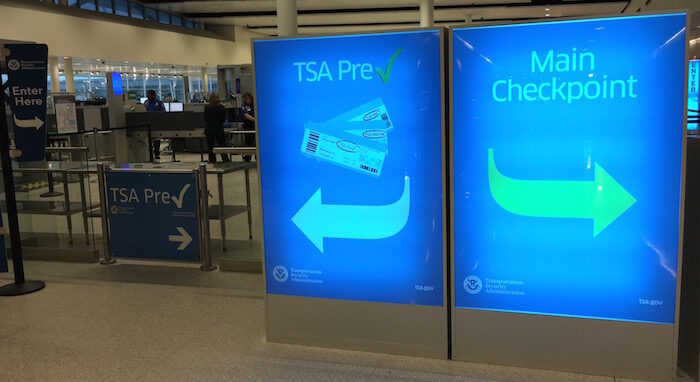
PreCheck gives you your own lanes at Checkpoints 1 and 2 and lets you keep your shoes, belt and light jacket on, with laptops and liquids left in your bag. Membership lasts five years. As of November 2026, the TSA lists three enrollment providers at slightly different prices:
| Provider | New enrollment | Online renewal | In-person renewal |
|---|---|---|---|
| IDEMIA | $79.75 | $58.75 | $66.75 |
| Telos | $84.95 | $69.95 | $58.75 |
| CLEAR | $84.95 | $72.95 | $84.95 |
A new application includes a visit to one of more than 1,300 enrollment locations, so apply well before a trip rather than the week of it. Once approved, add your Known Traveler Number to every airline booking. The indicator prints on the boarding pass only when the number is in the reservation and the airline participates; among the international airlines at AUS, British Airways is on the TSA’s list.
Children get a lot of the benefit for free. The TSA says children 12 and under can go through the PreCheck lane with a parent or guardian who has the indicator. Teens from 13 to 17 need the indicator on their own boarding pass, which requires being on the same reservation as the enrolled adult, and they can still be randomly left out.

PreCheck Touchless ID
Checkpoint 1 also runs a PreCheck Touchless ID lane, which uses only your face as ID. You need to be a current PreCheck member with a valid passport, and you opt in either through a participating airline’s profile or with a passport-backed ID pass in Google Wallet. The TSA lists American, Alaska, Delta, Hawaiian, Southwest and United as participating airlines.
Once the TSA confirms you, a Touchless ID indicator appears on your mobile boarding pass. If it isn’t there for a particular flight, use the ordinary PreCheck lane. Always carry your physical ID anyway.
CLEAR
CLEAR doesn’t replace screening; it replaces the ID check at the front of the line, and then you join the physical screening. At AUS that means Checkpoint 1 if you also have PreCheck and Checkpoint 3 if you don’t. As of November 2026, CLEAR+ costs $219 a year, and you can add up to three family members or friends for $125 each; CLEAR says kids can come through with a member for free.
Whether it’s worth the money depends on how often you fly and whether you already have PreCheck. PreCheck alone gets you its own lanes for under $85 for five years; CLEAR on top of it mostly saves the time at the ID podium on busy mornings.
Global Entry
Global Entry is CBP’s trusted-traveler program for coming back into the country, and it includes TSA PreCheck. As of November 2026 the fee is $120 for five years, and CBP charges no fee for minors when a parent is enrolled or applying. If you fly abroad even once a year, it covers both ends of the trip for $120, not much more than PreCheck alone, and AUS enlarged its international arrivals area with more booths in 2025.

Pack and dress for the bins
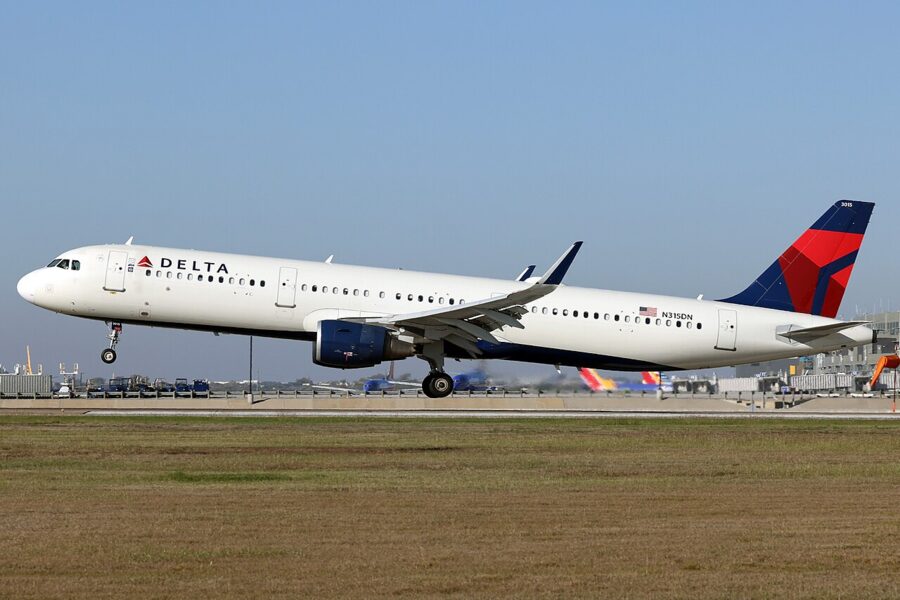
In a standard lane, the TSA asks you to take out electronics larger than a phone (laptops, tablets, e-readers, game consoles) and to remove light outer layers such as jackets, vests and blazers, plus belts. Liquids, gels, aerosols, creams and pastes go in containers of 3.4 ounces (100 milliliters) or less, in a quart-sized bag, with exemptions for medications and children’s food. Packing so that each of those comes out in one movement saves you more time than any choice of checkpoint.
Spare lithium batteries and power banks belong in your carry-on, never your checked bag, and lithium-ion batteries are limited to 100 watt hours each; there’s more on batteries on a plane if you’re carrying camera or laptop spares. Prohibited items slow everyone down: the airport says the TSA found a record number of firearms at AUS checkpoints in a recent year, and every one stops a lane.
ID is the other trap. Since May 7, 2025, adults need a REAL ID-compliant license or another acceptable ID such as a passport. Since February 1, 2026, a traveler 18 or older without one can pay $45 for TSA ConfirmID, which lets the TSA try to verify identity some other way, and that takes time you won’t have in the 5am rush. Children under 18 don’t need ID for domestic flights.
Getting to the airport and into the right line
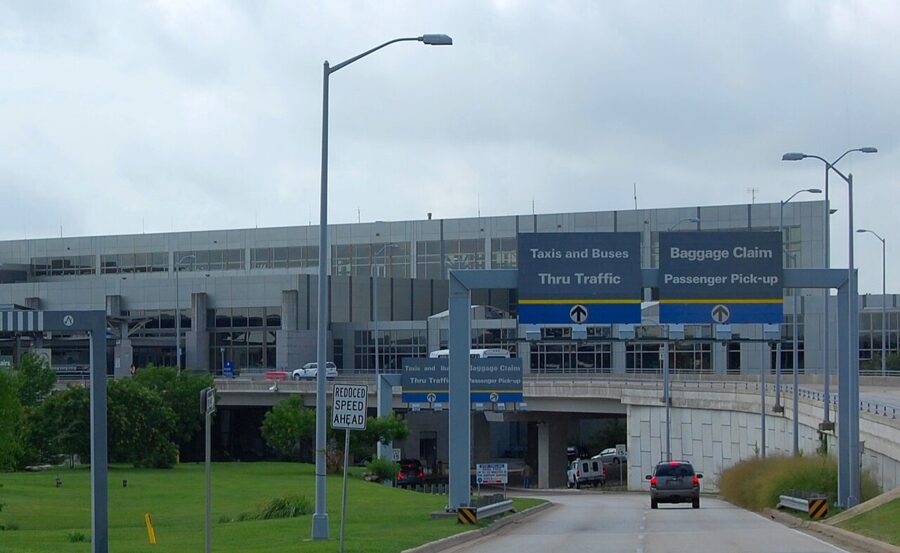
How you arrive changes when you reach the checkpoint. The airport suggests dropping off on whichever level is less congested, upper or lower, rather than joining the queue on the departures ramp; escalators and elevators take you up to the ticketing level. Drivers collecting arriving passengers can wait free in the cell phone lot at 2901 Spirit of Texas Drive.

Parking
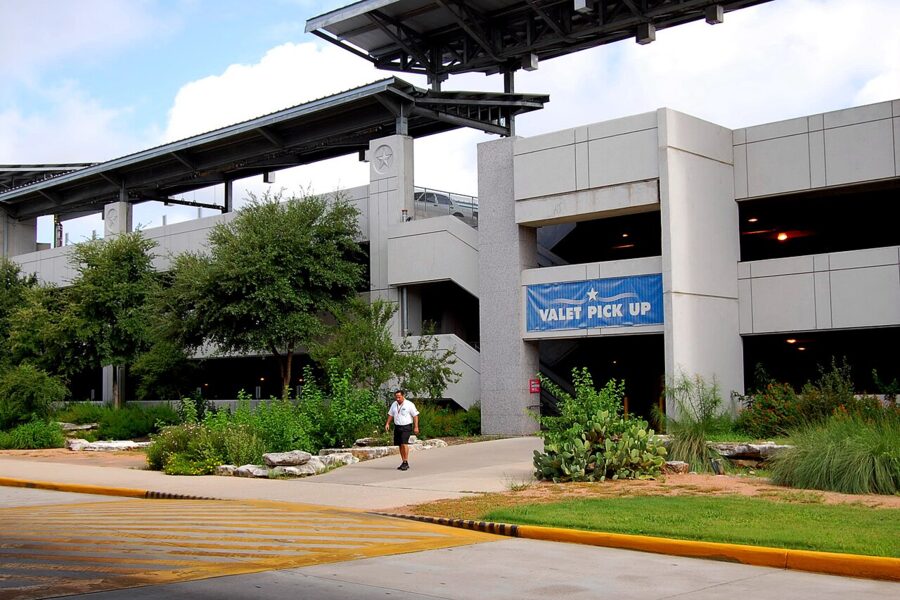
Parking is run by ABIA Parking: two garages beside the terminal plus Economy lots linked by shuttle. The Red Garage is the one closest to the terminal. ABIAParking.com shows real-time availability and rates and lets you book ahead, and the airport warns that lots can fill before holidays and busy travel days.
If you’re using the Economy lots, add the shuttle ride to your timing. A third garage, the 7,000-space Yellow Garage north of the Blue Garage, is under construction and expected to open in early 2027. Until it does, the Blue Garage exit ramp has intermittent overnight closures from 1am to 8am, with exits detoured through the Red Garage toll booth.

Bus, rideshare and check-in
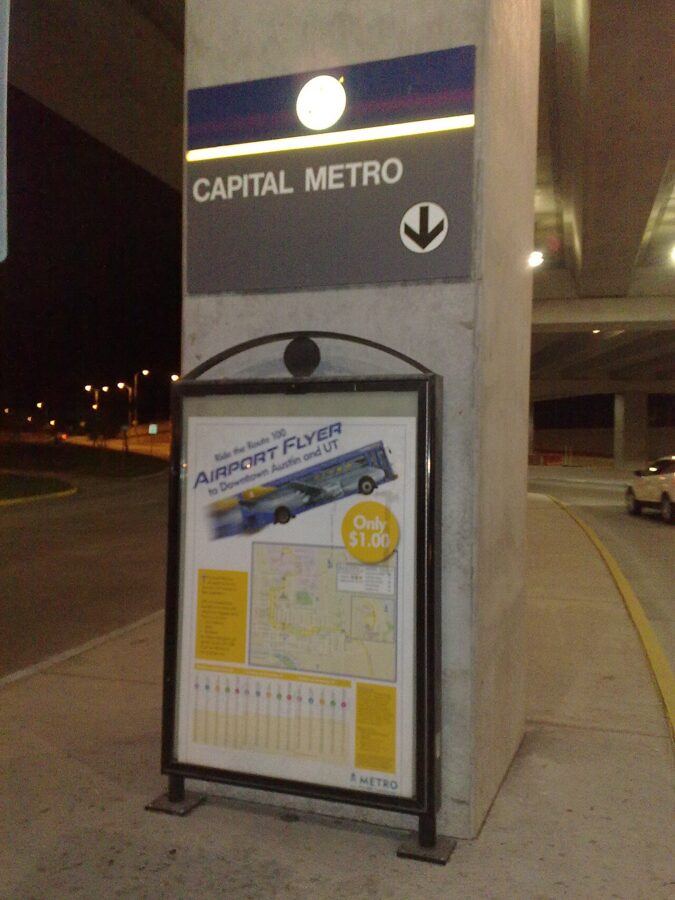
CapMetro Route 20 runs to the airport every 15 to 30 minutes, seven days a week, for a $1.25 fare, and Route 483 covers the hours after midnight to 4am. The stop is on the lower level just outside baggage claim. Rideshare pick-up is on the ground level beneath the Consolidated Rental Car Facility, behind the Red Garage.

Check in before you get there. Without checked bags you can skip the airline counters entirely with a mobile boarding pass; the airport also lists self-service kiosks and curbside check-in with some airlines. Counter and bag-drop hours vary by airline, so check your airline’s cut-off if you’re checking a bag on an early flight.

The South Terminal has closed, and the main terminal is still changing
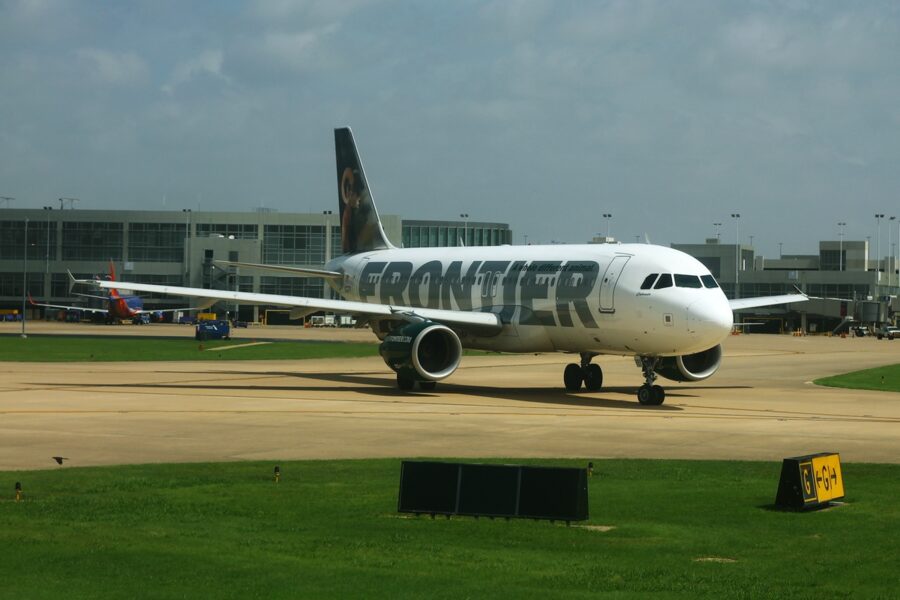
The South Terminal, the small separate building near US 183 and Burleson Road that opened in April 2017, closed after its last day of operations on March 31, 2026. From April 1, Allegiant and Frontier moved into the Barbara Jordan Terminal, using gates in the West Gate expansion area, so their passengers now check in and go through the same four checkpoints as everyone else. Directions that still send you to 10000 Logistics Lane are out of date.

The closure clears the site for new midfield taxiways, part of the airport’s Journey With AUS expansion program. Inside the main terminal, the work is close enough to passengers that you’ll walk past it:
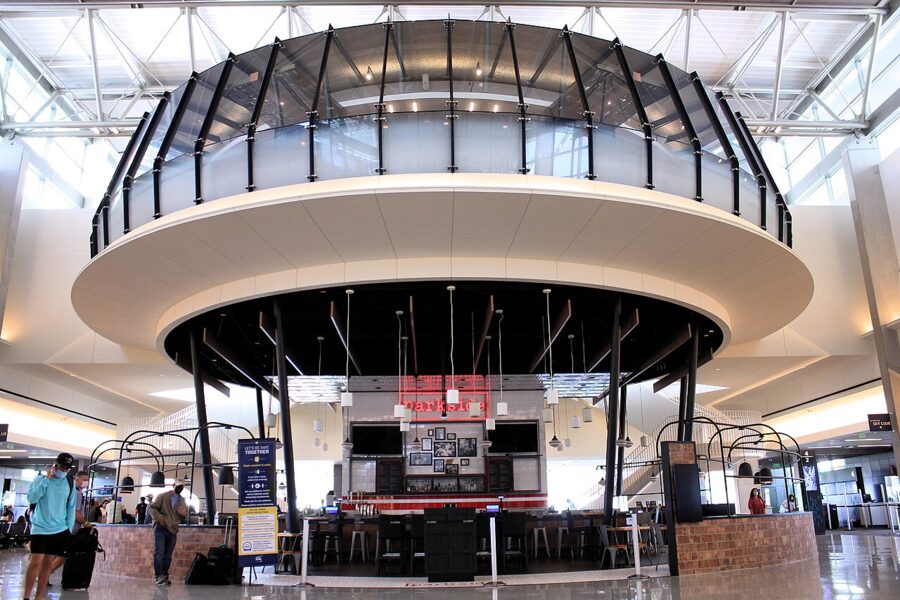
- West Gate Expansion: 84,500 square feet over three levels, three new gates and 12 replaced boarding bridges, with completion estimated for late 2026. Until December 6, 2026, one restroom there closes each night from 9pm to 6am for glass installation; there are more next to Gate 25.
- Atrium Infill: about 12,000 square feet of new floor above baggage claim for security screening, bag check and passenger processing, under construction through 2026, with noisy work mostly between midnight and 8am.
- Concourse M: a temporary six-gate building in the middle of the airfield, reached only by shuttle bus from Gate 13. Construction is expected to start in 2026 and it could open by spring 2028; since the shuttle leaves from Gate 13, passengers will clear one of the main checkpoints first.
- A new Arrivals and Departures Hall with a centralized TSA checkpoint, and Concourse B, a 26-gate midfield concourse linked by a tunnel, with 18 gates for Southwest, five for United and three for common use. The airport estimates both will open in the early 2030s.

For security, the near-term effect is good news. Checkpoint 4 is new, every checkpoint has CT scanners, and the Atrium Infill adds screening space. The airport describes the program as turning AUS from a medium-sized airport into a large one, and in the meantime construction walls and detours are part of the trip.

AUS security at a glance
- When to arrive (airport advice, November 2026): two hours before a domestic flight, three hours before an international flight, two and a half hours before a domestic flight on busy days.
- Checkpoints: four, all in the Barbara Jordan Terminal, all leading to every gate. PreCheck at 1 and 2; standard screening at 3 and 4; CLEAR at 1 (with PreCheck) and 3.
- Hours: the first checkpoints typically open at 3am. After about 8pm, the TSA’s counts show only Checkpoint 1 still screening.
- Busiest times: about 5am to 7am, then late morning to mid-afternoon. Sundays, Mondays and Thursdays are heaviest; Tuesdays and Saturdays lightest.
- Peak days in 2027: SXSW and spring break (March 15 to 21), the Monday after the Formula 1 race (October 25), the two ACL weekends in early October, three-day weekends and Thanksgiving.
- Before you go: MyTSA for historical busyness and reported waits, FlyAustin.com for busy-day warnings, ABIAParking.com for parking space.
- ID: REAL ID or passport for adults; without one, TSA ConfirmID costs $45.
If you’re flying out on the Monday after a big Austin weekend, book the parking and check in the night before, then leave for the airport as if your flight were half an hour earlier than it is.